What does schooling look like across three generations of an Afghan family? From Soviet-era fines for skipping class, to lessons held in animal stalls, to today’s growing private school sector — this is a look at how education in Afghanistan has changed across three generations.
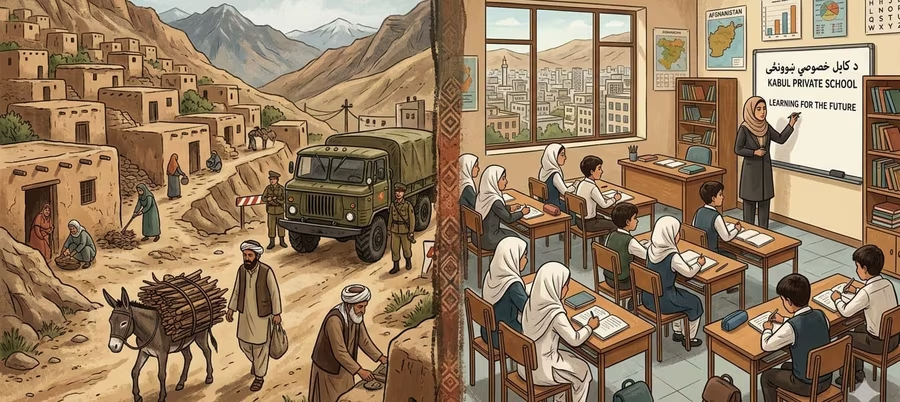
Grandfather’s Time: The Soviet Era (1980s)
During the 1980s, Afghanistan was under Soviet administration. The Soviets invaded in December 1979 and remained until their withdrawal in 1989. One thing they enforced during this period was compulsory schooling — every child had to attend, which in principle was a reasonable policy.
But many fathers of that era did not want to send their sons to school. There was simply no one else to help with the work on the farm. So every year, some paid a fine to essentially buy their child out of the schooling requirement. The fine was reportedly worth roughly one or two sheep.
We Have No Daughters
Families in the villages hid their daughters. No one wanted their daughter enrolled in a Soviet-run school — the fear was that literacy would lead to communism, and communism would lead to abandoning the religion. When word came that a government representative was heading toward a village, someone was sent ahead to warn the neighbouring villages. Inside the houses, daughters were told to go to a corner and stay still. Blankets, bedding, whatever was at hand — piled on top of them. If the representative entered and asked whether there were daughters in the household, the answer was always the same: we have none.
One Generation Later: Outdoor Classes and Animal Stalls (Early 2000s)
In the early 2000s, schools were far from modern. Many did not even have proper buildings. In warm weather, lessons could be held outside. But come autumn and winter, students had no choice but to sit with the animals in stalls and barns — at least it was warm there.
After the Taliban fell in late 2001, UNICEF provided schools with tents as a first step. Later, through the 2000s, with international aid flowing in, schools in the cities gradually managed to construct actual buildings.
But buildings were not the only problem. Teachers were often underqualified, or simply did not show up. Textbooks were poor quality — thin paper, riddled with errors.
Today: Private Schools and New Books (2010s–Present)
From around the 2010s onward, private schools have become a real option for families who can afford the fees. These schools tend to have better equipment, though most operate out of rented buildings. Their teachers are younger and more motivated, and the management maintains stricter oversight of both discipline and instruction. The Ministry of Education also permits private schools to teach a limited number of their own chosen subjects.
On the public side, the government — with assistance from Iran — has released a new series of textbooks. These are an improvement both in physical quality and in content.
Three generations, three very different relationships with school. The distance traveled is real, even if the road ahead remains long.
Do you have a comment or something to share? contact us: info@aboutafg.com