Attendance tracked by biometrics. Parents notified by SMS when a child is late. Fees recorded in a financial system. Teachers no longer filling out paper reports for the Ministry of Education by hand. This is how a growing number of Afghan schools now run their administration.
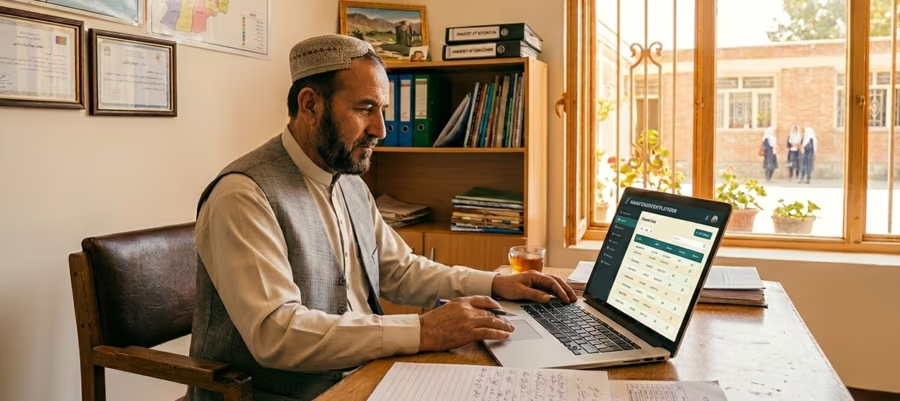
Private schools in Afghanistan have grown steadily since the 2010s. Running one means a constant stream of work for everyone involved:
- Teachers and administrators no longer fill out attendance sheets and Ministry of Education reports by hand — the software handles it
- Students and parents can check attendance records, homework, and academic progress, receive live notifications, and submit requests directly — without having to visit the school
Several software systems now make this possible — in private schools and, increasingly, in public ones too.
Modeer (مدیر)
By: Sky Technology · skytechnology.dev · Facebook · YouTube
Modeer — the word means “manager” in Dari — is a school management system used in both private and public schools across Afghanistan. According to Sky Technology’s product page, it covers the main administrative tasks a school deals with daily:
- Student registration and assessment tracking
- Financial management and reporting
- Biometric attendance for both students and staff, with real-time reporting and monitoring
- SMS notifications to parents when a student is marked absent or late
- Identity card design, printing, and exam management
- A companion mobile app (Modeer Parents App) for checking grades and receiving school notifications in real time
The system supports three languages: Dari, Pashto, and English. Schools across multiple provinces are listed as users — both private and public — with testimonials pointing to gains in transparency and a significant reduction in paperwork.
The SMS notification feature is worth noting. Building attendance alerts around SMS rather than relying solely on an app means the system reaches parents who pick up calls and texts more readily than they open apps — and that is most parents.
Customer support: The company states “your success is our mission” and lists excellent support as a core feature.
Rahnamood (رهنمود)
By: Bright Script · brightscript.af
Rahnamood — “guidance” in Dari — is described by Bright Script as a computerised and automated web application for school management. Its standout feature is dual-mode operation: the system runs both online and offline, which means it keeps working when the internet connection drops. It covers all school departments in one platform and supports Dari and Pashto.
Bright Script also offers hosting services, so schools that need help deploying the system have a path to do that through the same company.
Customer support: The company runs a helpdesk and describes it as “impatiently waiting” for questions, orders, or problems.
FastBooks (فست بوک)
Website: fastbooks.info · Facebook: fastbooks.kabul
FastBooks is a Kabul-based ERP software company. Alongside general business modules, it offers dedicated editions for schools, universities, and training institutes. The system covers invoicing, expense tracking, multiple user roles with separate access rights, and multi-branch operation with independent accounting and reports for each branch — useful for school networks with more than one campus.
The school edition is marketed as “دیتابیس برای مکتب” (a database for school), and a demonstration is available on YouTube. The company’s website was under maintenance at the time of writing, so the full feature list is not currently accessible online.
Customer support: No specific support information published online.
TechKhoona
Website: techkhoona.com
TechKhoona’s educational ERP is built specifically for Afghan schools and institutes. It supports both Pashto and Dari and covers:
- Student admissions from application through to enrolment
- Attendance tracking for students and faculty
- Examination management: scheduling, tracking, and results
- Curriculum and timetable administration
- Library management
- HR functions including employee recruitment
- Role-based access for different staff types: headmaster, department heads, teachers, librarians, admin
The company positions it as suitable for educational organisations of any size, from small schools to larger institutions.
Customer support: A contact page is listed on their website, but no specific support channels or details are published.
Afghan Cosmos (افغان کاس موس)
Website: afghancosmos.com · Facebook: Afghan Cosmos
Afghan Cosmos is a Kabul-based software development firm founded in 2022. Their work spans web development, mobile apps, and custom software, with education-related app development listed as one of their focus areas. They do not appear to have a specific named school management product, but have done work for educational clients. If you have used their services in a school context, we would like to hear more.
At a Glance
| System | Developer | Languages | Notable Features | Customer Support |
|---|---|---|---|---|
| Modeer | Sky Technology | Dari, Pashto, English | Biometric attendance, parent SMS alerts, parent mobile app | Phone, email, Facebook, YouTube — claims excellent support |
| Rahnamood | Bright Script | Dari, Pashto | Online and offline operation | Phone, email, helpdesk |
| FastBooks | FastBooks | Dari | ERP with school, university, and institute editions | Not published |
| TechKhoona | TechKhoona | Dari, Pashto | Full educational ERP with HR and library management | Contact page only |
| Afghan Cosmos | Afghan Cosmos | — | General software development firm; education-related work | Not published |
Where Things Stand
School administration is unglamorous work — tracking, recording, reporting, notifying. For teachers in particular, a significant part of that load has historically been paper: attendance sheets, grade records, and periodic reports submitted to the Ministry of Education by hand. Software handles this now. The design choices in these systems reflect the broader context: offline operation where connectivity is unreliable, SMS alerts rather than app-only notifications, Dari and Pashto as primary languages rather than an afterthought.
Private schools are the primary market, but adoption is not limited to them. Modeer, for instance, is in use in public schools as well. Government schools have historically faced more constraints around budget and procurement, but the barrier is not absolute — and where the tools prove their value, they tend to spread.
Do you have a comment or something to share? contact us: info@aboutafg.com