Moving money in Afghanistan is a mix of old and new. People use banks, traditional sarafis, and international platforms—each with its own rules, risks, and costs.
Local Banks: Accounts, Transfers, and Fees
Opening and Using Accounts
Afghans can open bank accounts in Afghani or USD. You can:
- Deposit money into someone else’s account at a branch
- Withdraw from any branch or ATM—even in another province
- Enjoy free local transfers (no fees)
International Transfers (SWIFT)
For sending or receiving money internationally, Afghan banks only support SWIFT transfers:
- Only USD accounts are supported
- Other currencies are automatically exchanged to USD
- SWIFT fees: $30–50 per transaction (sending or receiving)
- If a transaction fails or is reversed, extra fees apply (sometimes as much as $70)
- Example: A failed $200 transfer could leave the sender with only $80 returned after all fees
Large Transfers and Risk Management
Large incoming transfers (like $4,000 or more) are flagged by bank risk management. The bank will ask for documents to prove the source.
Tip: For people with international jobs, it helps to give a copy of your contract to your local branch in advance.
Da Afghanistan Bank and Sara-i-Shahzada
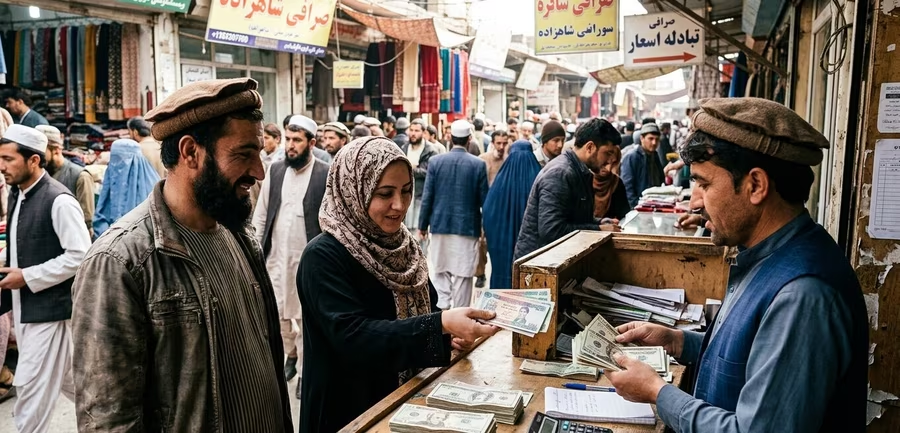
Da Afghanistan Bank is the main government bank, managing the national currency and ensuring its value in general. The real exchange rate, however, is set by the money market at Sara-i-Shahzada in Kabul—the central hub for all sarafis (money exchangers) in Afghanistan. Sarafis are found all over the country, but Sara-i-Shahzada is their main reference point.
Sarafis: The Traditional Money Movers
What Sarafis Do
Sarafis are more than just money exchangers. They:
- Exchange currency (Afghani, USD, and others)
- Move money within Afghanistan and internationally
- Keep deposits for clients (you can withdraw from any branch if they have more than one)
- Sometimes act as a neutral third party in business deals (like an informal letter of credit):
- If two people want to do a deal, they both go to a sarafi in person and put the money with him as a neutral third party. The sarafi writes a formal and binding contract with both parties, holds the money, and only releases it when both return together and confirm the business is done and both are satisfied. This provides trust and security for both sides.
Communication is often arranged via WhatsApp, but all transactions are formally documented on paper. Some sarafis now also use their own software, though there is no centralized system.
Fees and How They Work
- Domestic transfers: usually about 1% fee
- International transfers: fees are negotiable, typically 1–3% to send money abroad, and usually 3% to receive from abroad
Domestic sarafis are officially registered in Afghanistan, with licenses issued by the Ministry of Economy. However, since there’s no centralized software, there’s a risk of black-market transactions or money laundering.
Sarafis Outside Afghanistan
Outside Afghanistan, the picture is different — sarafis operating abroad are not under the same licensing framework:
- Transactions are often cash-only with no formal receipts
- Access is typically limited to clients referred by someone known to the sarafi
In some cases, with good commission, bank transfers are possible, but transactions often come in smaller amounts from different accounts.
International Transfer Platforms
Several platforms operate in Afghanistan:
- Western Union: Available at local banks. Instant transfers, free reversals, but high fees and poor exchange rates.
- MoneyGram: Similar to Western Union, but usually better rates and lower fees.
- Ria: Available through some sarafis. When sending money, you can specify which sarafi in Afghanistan the recipient will collect from—this is officially listed on Ria’s website. Fees and exchange rates are often as good as MoneyGram.
- Wise: Not officially supported in Afghanistan, but some sarafis can facilitate Wise transfers through their contacts outside the country. Sometimes, the sender gives cash to the sarafi, who then asks a partner abroad to send the money via Wise to the recipient. In other cases, both the sender and receiver are outside Afghanistan, and the local sarafi simply arranges or holds the deal for them. Wise accounts themselves cannot be used inside Afghanistan.
What to Watch Out For
- Bank and SWIFT fees can be high, especially if a transaction fails.
- Sarafis inside Afghanistan are licensed and contract-driven; outside Afghanistan, always use one referred by someone who has worked with them directly.
- Large transfers may be flagged for extra checks.
- International platforms are often better value than banks.
Money moves in Afghanistan through a well-established mix of licensed sarafis, formal banking, and international platforms—each suited to different needs and amounts.
Do you have a comment or something to share? contact us: info@aboutafg.com