Whether you get real medical care in Afghanistan often comes down to one thing before your symptoms even matter: what you can pay. That single fact splits the system into four different kinds of hospitals, each with its own rules for who foots the bill.

Access to quality health care is a basic right. In Afghanistan, whether you get it comes down to money.
Money Decides Where You End Up
There is no health insurance in Afghanistan — no private plans, no state-funded scheme. Whatever treatment costs, someone pays for it directly: the patient, the hospital itself, or a charity standing behind it.
If you need health care in central Afghanistan, the first thing that decides your options is your economic situation. More standard, reliable care tends to be found in private health centers — and private care costs more. If you cannot afford that, you go to a government or organizational hospital instead, and accept a lower standard of care.
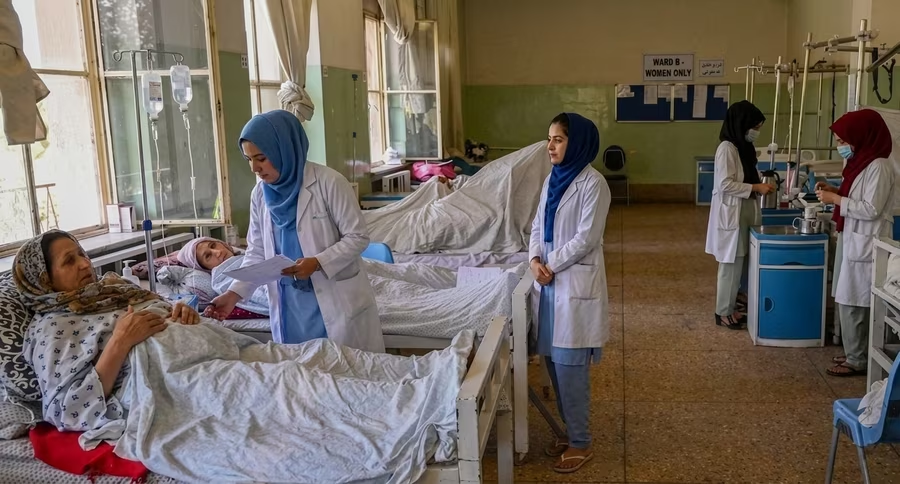
At government and organizational hospitals, the quality of treatment often does not match what it costs in time and effort. Walk into a government hospital and you will see it crowded with patients who could not afford private care, some of whom have traveled in from other provinces. Many go there assuming treatment will be cheaper — but because the hospital itself lacks facilities, the actual diagnosis and required medication often end up coming from the private sector anyway.
Four Types of Hospitals
Here is how each type’s funding works, and who ends up paying for what.
Government Hospitals
Government hospitals operate under state administration. All hospital costs are covered by the government, and patients usually pay nothing for doctor visits or their hospital stay. Government hospitals exist in the capital and in provincial centers — examples include Ibn Sina Hospital, the 400-Bed Hospital, Sehat-e-Tifl (the children’s hospital, officially the Indira Gandhi Institute of Child Health), and Jamhuriat Hospital.
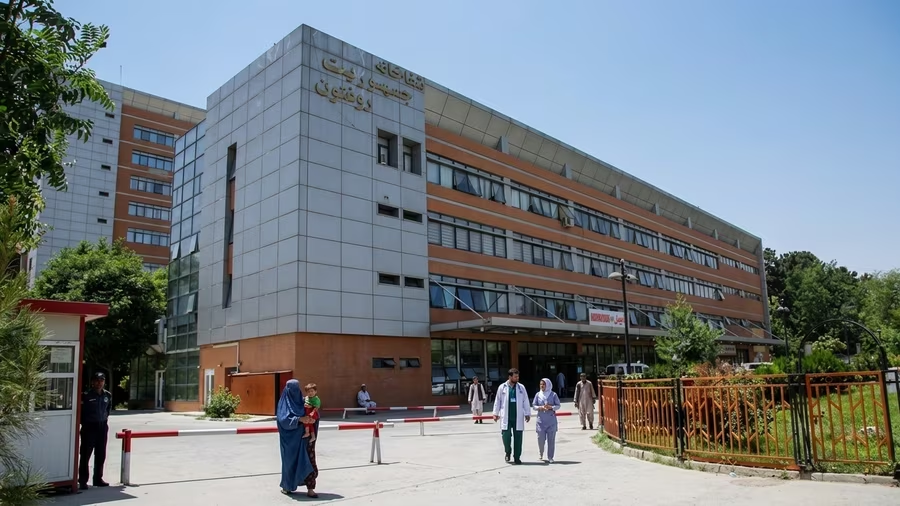
The doctors leading these hospitals — as head doctor or ward head doctor — are often among the most experienced in the country. But there are too few of them for the number of patients who come through each day, and many also run a private practice on the side, where they refer their own government-hospital patients — one more route by which a visit that started as government care quietly becomes a private-sector bill.
Private Hospitals
Private hospitals are built and run with private money. They do not share treatment costs with patients, unless a patient qualifies for charity care. Amiri Medical Complex and Khairkhwa Medical Complex, both multi-specialty tertiary hospitals in Kabul, are examples of this type.
Semi-Government Hospitals
These operate under an agreement where the government contributes to costs based on the hospital’s performance, and the hospital covers part of the patient’s final treatment bill.
Organizational (NGO-Run) Hospitals
These are funded and equipped by international charitable organizations, and cover as much of a patient’s treatment cost as they can. Emergency, a surgical hospital in Kabul, is a well-known example of this type — it runs on private donations along with funding from the WHO, the Common Humanitarian Fund, and the EU. The ICRC runs a separate program of its own, covering staff salaries and supplies at dozens of hospitals nationwide rather than funding a single facility.
FMIC: A Case of Its Own
FMIC, the French Medical Institute for Mothers and Children pictured at the top of this article, does not fit neatly into any of the four types above. It runs through a partnership between the governments of Afghanistan and France, the Aga Khan Development Network, and the French NGO La Chaîne de l’Espoir, with the Aga Khan University managing it day to day, and it is widely regarded as having the highest clinical standards in the country. Despite that mixed public and charitable backing, its fees are at or above private-hospital levels: a blood test that runs 150 to 200 AFN at another private clinic can cost 1,000 to 2,000 AFN at FMIC. One family was reportedly quoted 500,000 AFN there for a heart surgery, and used that same amount instead to fly to New Delhi, cover two weeks of stay, and have the surgery done at Max Hospital — not a cheaper option, but a similar price for a trip abroad instead of treatment at home.
Where the System Struggles
Underneath all four types sits the same set of shortages. Afghanistan’s health system runs into a wide range of infrastructure problems:
- Training facilities, pharmacy services, and diagnosis and treatment capacity are all stretched thin
- Not enough standard hospitals to match the number of people who need care
- Facility and staff shortages that make hospital sanitation worse, driving patient dissatisfaction and contributing to the spread of disease among the people being treated
- Administrative disorder, weak staff conduct, and corruption and favoritism in how services are handed out
The health workforce has grown noticeably over the past few decades, but Afghanistan’s population density and geography mean that standard-quality care is not easy to reach for anyone outside the provincial and national centers. Where trained staff, infrastructure, and equipment are all missing at once, patients sometimes die as a direct result.
When Patients Go Abroad
Not every patient who needs care stays in the country. Iran, Pakistan, and India are the main destinations, though medical-visa rules for all three have tightened in recent years amid shifting regional politics. Pakistan has gone further than the other two, opening hospitals in its border cities specifically to receive Afghan patients, and in Delhi, residents living near well-known hospitals such as Apollo and Max have taken to renting out rooms to Afghan families staying nearby for treatment.
Patients and families reportedly go abroad for three main reasons:
- They don’t trust the diagnosis or treatment on offer at home
- Even after paying for travel and a visa, treatment in Pakistan still costs less overall, sometimes
- A hospital in Afghanistan refers the case abroad directly because the treatment it needs is too complex to handle domestically
None of this is new. When relations between Afghanistan and Pakistan were better, hospitals in Kabul routinely sent blood samples to Pakistani labs for testing, dentists ordered implants built to a patient’s specifications there, and opticians ordered glasses through Pakistani suppliers — a working relationship between the two countries’ health systems that existed well before patients started crossing the border themselves.
Where That Leaves Patients
Going abroad is only an option if you can afford the trip — for most patients, the real choice still stays between the four types of hospital at home. The type of hospital you can reach rarely matches the type of care you actually need. That gap is what the next piece in this series looks at directly — through what patients and their families say happened to them, ward by ward. Check back soon.
Do you have a comment or something to share? contact us: info@aboutafg.com