Afghanistan has one of the highest rates of disability per capita in the world — a legacy of four decades of war. What happens next, at school or at work, usually has less to do with government policy than with who happens to step in.
Almost every number in this post comes from a UN agency, an NGO, or a survey conducted in Afghanistan — and none of those should be read as exact:
- Surveys are self-reported. What a family or a clinic reports can shift depending on what they think the count is for — inflated if it’s tied to aid, understated if it’s tied to stigma, taxes, or conscription.
- NGOs have an interest in the numbers, too. The same organizations reporting how big a problem is are often the ones asking donors to fund fixing it.
Treat every figure below as a rough order of magnitude, not a precise count.
Why the Numbers Are So High
The United Nations estimates that around 1.5 million Afghans live with a significant disability. A 2019 national survey puts the wider picture at:
- 80% of Afghan adults report some degree of disability, though most of it is mild
- 14% of adults have a severe disability
- 1 in 5 households has a family member living with a disability
A Legacy of War
Decades of war explain a large share of the country’s severe cases:
- 17% of severely disabled Afghans — 126,000 to 146,000 people — were disabled directly by fighting
- 52,000 to 60,000 people are landmine or unexploded-ordnance survivors
- 1,150+ km² of Afghan territory is still contaminated with mines and other explosive remnants of war
A Bigger Driver Today: Marriage Between Relatives
War isn’t the main source of new cases, though. Marriage between relatives is common in Afghanistan, and it carries a documented genetic cost:
- 46% of marriages nationally are between relatives, one of the highest consanguinity rates in Asia — regional surveys in the west and south put it as high as 59%
- Children of consanguineous marriages face a 3.5 times higher risk of hereditary hearing loss
- Researchers link Afghanistan’s consanguinity rate to some of the world’s highest carrier rates for inherited blood disorders like beta-thalassemia
- By the ICRC’s own count, only about 10% of new patients registering at its rehabilitation centers today are there because of war — the rest live with congenital conditions, disease, or injuries from accidents
Every country has people with disabilities. What sets Afghanistan apart is the scale — and what that scale has forced into being: a set of schools, workshops, and rehabilitation programs, run largely by disabled Afghans themselves, doing the work no government program has managed to do consistently.
School: More Common Than You’d Expect, Still Far From the Norm
Dedicated schools for children with disabilities are less rare than most people assume — but nowhere near universal.
Deaf Education
The Afghan National Association for the Deaf (ANAD) partnered with the nonprofit Mountain2Mountain in 2012 to build what organizers called Afghanistan’s first K-12 school for Deaf children, in Kabul. Alongside classrooms, the project included a teacher-training center and a farm for vocational skills, aimed at training Deaf graduates to become teachers themselves and eventually open more schools elsewhere in the country. An estimated 10,000 Deaf children live in Afghanistan.
Separately, Serve Afghanistan built a school for hearing-impaired children in 1996 and handed it over to the Afghan government in 2016. Since then, the group has trained more than 1,137 teachers in Braille and Afghan Sign Language, and helped transfer 19 “model schools,” which mix special-needs and mainstream classrooms, to the Ministry of Education.
Blind Education
For blind children, the Kabul Vocational Institute for the Blind teaches around 300 students — 200 boys and 100 girls — from grade 1 through grade 14. Alongside the regular curriculum, students learn Braille, Quran recitation, and trades like brush-making and chair weaving. One graduate, known as Qari Khalid, went on to place in national Quran recitation competitions. Girls attending this institute through grade 14 stands out against Afghanistan’s wider ban on girls’ education past grade six — how the two policies coexist isn’t something the reporting explains, but it’s what’s on record.
Outside institutions like these, a child with a disability in a village or a smaller city usually has no dedicated school to go to at all. Whether they learn anything comes down to family and community, not any structure built to reach them.
Work: A 3% Quota, and Where It Actually Holds
Afghanistan’s 2010 law on the rights of persons with disabilities reserves 3% of jobs, in both government and the private sector, for people with disabilities. Across the civil service, that mostly stays on paper: of roughly 376,000 government employees, the quota calls for about 11,280 of them to have a disability, and only around 637 actually do — under 0.2%.
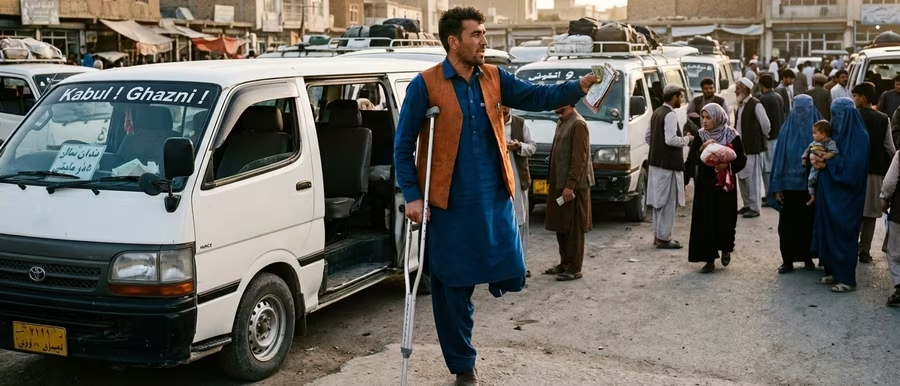
One corner of the labor market where the reservation does hold is at city bus and van stands. Calling out destinations, collecting fares, and directing which vehicle goes where is a job the government designates specifically for people with disabilities — someone without one is not permitted to take it. It’s a narrow slice of the economy, but it’s the rare case where the policy on paper matches what actually happens on the street.
Beyond that one carve-out, the largest deliberate source of jobs for disabled Afghans isn’t the government at all — it’s the ICRC’s rehabilitation program.
The ICRC’s Rehabilitation Program
The International Committee of the Red Cross has run a physical rehabilitation program in Afghanistan since 1988.
Scale
- Started in Kabul as a single center fitting prosthetic legs for war amputees
- Now operates seven centers nationwide: Kabul, Jalalabad, Faizabad, Mazar-i-Sharif, Herat, Gulbahar, and Lashkar Gah
- Treats more than 150,000 people a year
- Has registered around 210,000 patients since it began
Staffing
- Nearly all of its roughly 815 staff have disabilities themselves, many of them former patients — a staffing policy Alberto Cairo, the Italian physiotherapist who has led the program since 1990, calls “positive discrimination”
- The program runs a certified school that trains people with disabilities as prosthetic and orthotic technicians
- It has issued nearly 11,000 small loans for businesses in trades like tailoring, carpentry, and welding
Funding
- When the ICRC pulled funding from 25 government hospitals in 2023 amid a wider aid squeeze, it kept funding the rehabilitation centers
- Humanity & Inclusion (formerly Handicap International) has worked in Afghanistan since 1996, running a separate program covering rehabilitation, mine-risk education, and support for disabled-led organizations
- It resumed work in four provinces after the aid pause that followed 2021
Where Afghans with Disabilities Are Winning
Some of the clearest wins show up in sport. Afghanistan’s wheelchair basketball program, formed in 2013 under the National Paralympic Committee and funded through the ICRC, now involves close to 400 players nationwide. The women’s team won its first international trophy in 2017, at the Bali Cup in Indonesia; the men’s team has won tournaments in Lebanon and played in Italy and Japan.
The most striking individual story is Zakia Khudadadi’s. Born without a forearm, she started training in taekwondo in secret at age 11, in a hidden gym in Herat. In 2021, after a secret evacuation from Taliban-controlled Kabul, she became the first Afghan woman to compete at a Paralympics since 2004. Resettled in Paris, she competed for the Refugee Paralympic Team at the 2024 Paris Games and won bronze in the 47kg category — the first medal the Refugee Paralympic Team had ever won.
My Take
None of this adds up to full inclusion. A quota nobody enforces isn’t a real system, and most disabled Afghans outside Kabul’s few dedicated programs still have no school or formal job to go to. But look at who is actually doing the work that does exist: technicians who were once patients themselves, Deaf teachers back at the school that taught them, a women’s basketball team with an international trophy, a taekwondo fighter with an Olympic medal. None of that came from a law or a foreign budget deciding to be generous — it came from disabled Afghans building it themselves. That’s the part worth paying attention to.
Do you have a comment or something to share? contact us: info@aboutafg.com