If you’ve ever heard someone say they speak “Persian” and wondered whether that’s the same as Dari or Farsi, you’re not alone. The relationship between these languages confuses a lot of people — even those who speak one of them. The short answer is: they all belong to the same Persian language family. The longer answer is worth understanding.
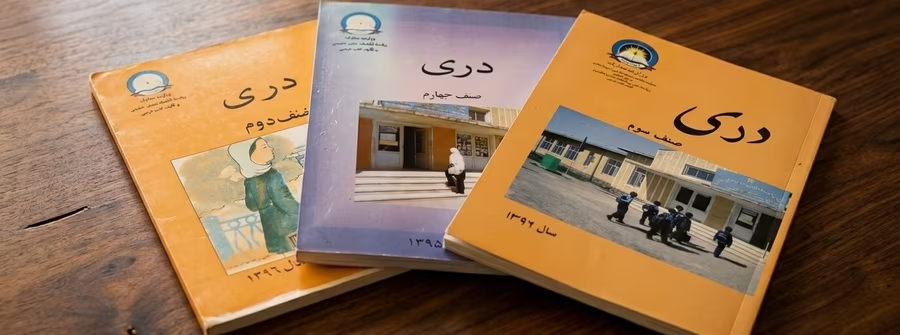
One Language Family, Three Very Different Forms
Afghanistan is a linguistically rich country. It is home to dozens of languages — including Pashto, Uzbek, Turkmen, Balochi, Nuristani languages, and many more. One of them is Dari, which is one of the country’s two national languages alongside Pashto.
Persian as a language family exists today in three official forms:
- Dari (ISO 639-3: prs) — spoken in Afghanistan
- Farsi (ISO 639-1: fa) — spoken in Iran
- Tajik (ISO 639-1: tg) — spoken in Tajikistan
These are not simply accents of one another. Dari and Farsi share the same Perso-Arabic script and a common grammatical foundation, but differ noticeably in vocabulary, pronunciation, rhythm, and everyday expression. Tajik diverges even further — it not only sounds different but is written in the Cyrillic alphabet, a legacy of Soviet rule in Central Asia, making it visually unrecognizable to readers of Dari or Farsi.
A rough analogy might be the relationship between Spanish, Portuguese, and Italian — related, with a shared ancestry, but distinct enough that fluency in one does not guarantee understanding of another.
A Brief History: Rooted in Afghanistan as Much as Anywhere
The name Dari is believed to derive from darbār (دربار) — the word for “court” in Persian. It was the language of the Afghan royal court in Kabul: the language of governance and refinement.
The story of Persian, however, is not the story of one country. Classical Persian — sometimes called Farsi-ye Dari (فارسی دری) in historical texts — emerged as the literary and administrative language of a vast region stretching from the lands of modern Afghanistan to Central Asia and beyond.
What is often overlooked in Western accounts is that the Persian-speaking world was shaped just as much from the east as from the west.
The city of Balkh in northern Afghanistan — one of the oldest cities in human history — was a major center of Persian culture and scholarship long before modern borders existed. The Ghaznavid dynasty, based in Ghazni, was among the most powerful patrons of Persian literature, with its empire stretching into Iran, Central Asia, and the Indian subcontinent.
Afghan rulers and dynasties repeatedly held power over vast Persian-speaking territories — a history that belongs to Afghanistan just as much as to any other nation.
Persian survived the Arab conquests of the 7th century and the Mongol invasions, enduring as a language of culture, poetry, and governance across the region. Over centuries, as borders hardened and modern nation-states formed, the varieties of Persian spoken in different places developed their own identities.
Can Dari and Farsi Speakers Understand Each Other?
To a degree — but not enough to move to the other country and get by without friction. Written documents, news broadcasts, and formal speech are close enough that both sides can generally follow. Day-to-day life is a different story. An Afghan moving to Iran, or an Iranian moving to Afghanistan, will quickly find that casual conversation — the way people talk at home, in the market, with friends — is full of words, expressions, and sounds that simply don’t match. The further from formal language, the wider the gap.
Vocabulary: Worlds Apart in Everyday Speech
Vocabulary is where Dari and Farsi diverge most visibly. Each variety absorbed words from its own geographic neighbors over centuries. Dari drew heavily from Pashto, Hindi-Urdu, and Turkic languages. Farsi, meanwhile, underwent active modernization efforts in the 20th century, replacing many older words with newly coined terms — sometimes from Arabic, sometimes modeled on European languages.
The result is that many common, everyday words are completely different:
| Meaning | Dari | Farsi |
|---|---|---|
| Airport | میدان هوایی (maidān-e hawāyi) | فرودگاه (forudgāh) |
| Car | موتر (motar) | ماشین (māshin) |
| Hospital | شفاخانه (shifākhāna) | بیمارستان (bimārestān) |
| Glasses (eyewear) | عَینَک (aynak / āynak) | عِینَک (eynak) |
| Now | هَمیالی (hamyāli, spoken) / اکنون (aknun, formal) | الان (alān) |
In many cases, Dari preserves older classical Persian words that have been replaced in modern Farsi — so to an Iranian ear, Dari can sometimes sound formal or even archaic, while to an Afghan ear, certain Farsi words can sound unfamiliar or foreign.
Pronunciation: A Fundamentally Different Sound
Pronunciation is the most immediately striking difference between Dari and Farsi — even for a non-speaker, the two varieties simply sound different.
The “w” vs “v” distinction: The letter و in Dari is typically pronounced as a clear w sound, while in Farsi it is pronounced as v. So the word for “and” — و — is wa in Dari and va in Farsi.
The “ai” vs “ei” vowel shift: Dari preserves a more open ai vowel sound in many words, while Farsi shifts it toward ei. A clear example is the word for Dubai: in Dari it is pronounced دوبَی (Dubay), while in Farsi it becomes دوبِی (Dubei). This shift runs through many common words and gives the two varieties a distinctly different sonic feel.
Letter merging in Farsi: Farsi has merged the pronunciation of several letters that Dari keeps distinct. The letters ق (qaf) and غ (ghain), for example, are pronounced differently in Dari but tend to collapse into a single similar sound in colloquial Farsi speech. This kind of merging makes Farsi sound smoother and faster to Afghan ears, but can also make it harder to follow.
Speech pace and rhythm: Farsi is generally spoken at a noticeably faster pace, with vowels shortened or swallowed. Dari, by contrast, tends to preserve vowel length more faithfully, giving it a slower, more deliberate rhythm that many describe as melodic or lyrical.
Exclamations and filler words: The two varieties have their own distinct set of everyday exclamations and emotional sounds. Where a Dari speaker might say ای وای (ay wāy) to express surprise or distress, a Farsi speaker reaches for وای (vāy) or آخ (ākh). These small words carry cultural texture that rarely translates directly.
Script and Writing: Same Alphabet, Different Details
Both Dari and Farsi use the Perso-Arabic script, written right to left — which already sets them apart from Tajik’s Cyrillic script. A reader of one can generally read the other, even if some words are unfamiliar.
That said, differences do exist in the written form:
Spelling conventions: The same word is sometimes spelled differently across the two varieties. The word for “what,” for example, is written چی (chi) in everyday Afghan Dari but چه (che) in Farsi. Another clear example is the word for “list”: in Dari it is لست (list), while in Farsi it is لیست (list) — same pronunciation, different spelling. These divergences reflect separate paths of standardization rather than errors.
How Farsi evolved while Dari stayed closer to the original:
Iran has a central institution — the Academy of Persian Language and Literature (فرهنگستان زبان و ادب فارسی) — whose role is to actively modernize Farsi: coining new words, replacing foreign borrowings with Persian alternatives, and standardizing both vocabulary and pronunciation. The pronunciation shifts described in the section above were happening naturally over time, but the Academy codified them as the official standard.
Dari, without an equivalent central body, retained much of its classical vocabulary and pronunciation. This is why Dari can sometimes sound more formal or archaic to Iranian ears — and why certain Farsi words sound unfamiliar to Afghans.
Regional accents within Afghanistan: Dari itself is not spoken the same way across the country. A Dari speaker from Kabul sounds different from one in Herat, Mazar-e-Sharif, or Bamyan — each region carries its own rhythm, vocabulary, and local colour. The same is true inside Iran, where regional differences also exist — but that is a separate matter from the Dari-Farsi divide.
Cultural Identity: Why the Name Matters
For Afghans, calling the language “Dari” is not a technicality — it is a statement of identity. It acknowledges a distinct Afghan cultural heritage, a literary tradition rooted in the landscapes and history of Afghanistan, and a living language shaped by the people who have spoken it for centuries.
The word “Farsi” refers specifically to the variety spoken in Iran. Using it to describe what Afghans speak flattens a real distinction — one that many Afghans feel strongly about, given a long history in which Afghan cultural contributions have been attributed elsewhere or overlooked entirely. An Afghan being told they speak “Farsi” may feel that their identity is being erased.
Same Roots, Different Flowers
Dari, Farsi, and Tajik all carry traces of an ancient shared language within them. But each has grown into its own form, shaped by the land, the neighbors, the rulers, and the stories of the people who speak it.
Dari is Afghanistan’s own — a language with deep roots, a rich literary tradition, and millions of speakers who use it to navigate everything from the marketplace to poetry.
Do you have a comment or something to share? contact us: info@aboutafg.com