Afghanistan’s schools are supposed to be sanctuaries of learning — places where young minds grow and futures are built. Yet in many governmental schools across the country, they have become something far different: overcrowded warehouses where teachers rarely teach, students rarely learn, and corruption runs unchecked. For decades, this system has persisted, forcing families to seek private tutoring at great expense, while the public education system crumbles.
This is not speculation — it is the daily reality for millions of Afghan students.
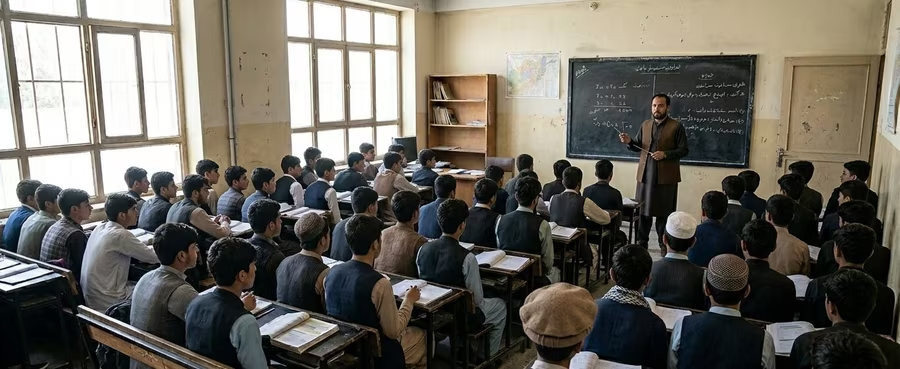
Overcrowded Classrooms
Even in high schools in Kabul, the situation remains dire. School buildings contain numerous classrooms, each holding approximately 70 students. In a typical high school with 12 grades and at least 5 classrooms per grade, a single shift accommodates 4,200 students (some schools run up to 3 shifts, with night shifts available for working students in grades 10–12).
When a classroom exceeds 50% capacity, it becomes nearly impossible to hear the teacher clearly. This creates a practical breakdown in instruction from the start.
Consider the population density: in busy areas like Pol-e-Bagh-Omumi in Kabul, over 20,000 students flood the streets during shift changes. This area alone hosts six high schools:
- Ansari High School (boys)
- Ariana High School (girls)
- Afghan Turk High School (boys)
- Ayeshe Dorani High School (girls)
- Esteqlal High School (boys)
- Amani High School (boys)
Teaching Hours and Teacher Availability
Each teaching period lasts approximately 35 minutes, with 6 periods per day and no breaks. Given the large school areas, teachers may need 10 minutes simply to move between classrooms. Adding reasonable breaks for exhausted teachers, even dedicated educators lose 20 minutes per class day to logistics alone.
However, dedication is not universal. On normal school days (when education ministry inspectors are absent), about 50% of teaching periods proceed without any teacher present. Teacher attendance is supposedly tracked in an “Education Progress” book (Taraqi Talim) that teachers must sign daily after teaching each of their classes. In reality, teachers sign entire weeks of records at once—often for classes they never actually taught, and often in front of the principal—without consequence.
Teacher Wages: A Systemic Problem
A highly skilled and talented teacher in a government school earns approximately €40 per month per shift — and this is for teachers with 5 to 10 years of experience. While experienced teachers do earn more than their newer colleagues, even these veteran educators are severely underpaid. This forces many to work multiple shifts across government and private schools just to earn a basic living.
Student Attendance Patterns
Students mirror this lackadaisical approach. On typical school days (excluding the final 1–2 weeks before exams), fewer than 40% of students attend class. Class representatives are responsible for taking attendance twice daily—at the first and last periods—but this rarely happens accurately. They simply mark present students and leave blanks for absent ones, updating records only after seeing students return days later.
Official rules state that excessive absences prevent students from sitting final exams. Yet most students bypass this with forged hospital certificates.
Common reasons students skip class:
- Start of the school year – Students often don’t return until 3 weeks after classes begin
- Weather – Rain or snow
- Post-holiday – The week following national holidays like Eid
- Teacher’s Day – A cultural observance
What Happens in the Classroom
Truly dedicated teachers teach from the moment they enter until they leave. But they are the minority. Many teachers lack proper subject knowledge—the principal may have assigned them classes outside their expertise. Others simply don’t care; they sit in a corner saying, “Do whatever you want, just be quiet,” as if students would voluntarily comply. Homework is not practiced at all, and practically impossible anyway—with 70 students in a single 35-minute period, how could a teacher assign or check homework for anyone?
Discipline Issues
Discipline enforcement falls to a single discipline teacher and a team of volunteer students (who also miss regular classes). At the entrance, this team searches students for prohibited items. Yet with only one teacher overseeing thousands and personal friendships among the volunteers, enforcement breaks down. Illegal items are readily found:
- Mobile phones
- Cigarettes and narcotics
- Weapons (knives and pistols)
Examination System Failures
Afghanistan’s examination system grants teachers complete authority over grading. A teacher can award 100 marks for a blank paper or zero for a perfectly correct one—with no accountability.
Each exam is supposed to have two responsible people: the teacher conducting the exam and an assistant invigilator. However, the assistant almost never appears. Even when alone with the students, teachers often make only minimal effort to enforce discipline.
In the first-term exams, papers usually contain 9 questions. In end-of-year exams, that number increases to 12. Questions are divided between two student groups with different versions to prevent cheating. Questions are read aloud, one group at a time. Once all questions are read, students write their answers. In practice, students begin discussing and writing responses while the teacher is still reading to the other group. Even after the teacher has completed reading all the questions, cheating continues, and teachers rarely intervene.
Language exams are designed with 4 written questions plus a speaking section. In practice, however, the speaking section is almost never conducted.
Sports exams are supposed to be held in open areas with practical evaluation, but in many cases teachers simply award full marks to everyone without even observing students.
The higher marks typically go to “front-benchers”—diligent students for whom grades matter academically. Back-benchers are satisfied simply passing.
Academic Trend: Nearly 99% of students fail the first term, yet nearly 99% pass the second term. In practice, many schools treat the first term as a display of strictness, then routinely pass students in the final term to move them to the next class, since keeping them in the same class is seen as pointless and against long-standing habit.
How Strong Students Actually Succeed
Students who truly excel turn to private tutoring classes and courses as their primary learning source. They attend full-time government school and then immediately enroll in full-time private courses—exhausting both academically and logistically, given poor transportation infrastructure.
Private courses focus on university entrance exams rather than foundational understanding, leaving gaps in basic knowledge.
Conclusion
Afghanistan’s governmental schools operate under severe systemic constraints: overcrowding, absenteeism (both teacher and student), weak discipline, and corrupted grading systems. These barriers make quality public education nearly impossible for average students. The reliance on expensive private tutoring as the only path to academic success widens inequality and places unfair pressure on families already struggling economically. Without structural reforms—reducing class sizes, enforcing accountability, improving teacher training, and implementing transparent grading—the cycle will continue, disadvantaging an entire generation.
Do you have a comment or something to share? contact us: info@aboutafg.com