A hand-knotted Afghan carpet can take months to weave and travel thousands of miles before it reaches a buyer who has no idea how it was made, graded, or named along the way. Here’s the full story — from the loom to the global market.
Origins
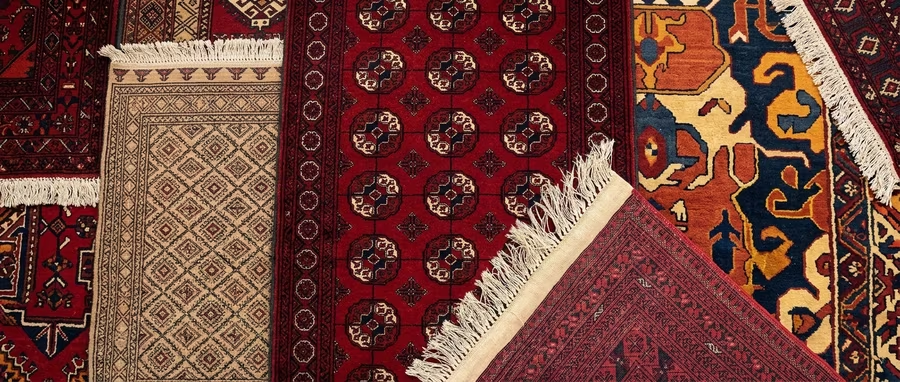
Afghan carpet weaving developed among several of the country’s ethnic communities — the Turkmen, Baluch, Hazara, Uzbek, and Tajik peoples — each shaping the craft with its own materials, dyes, and visual language. A durable, hand-knotted floor covering was practical for any household: something to use daily and pass down for generations.
Afghanistan’s position on the historic Silk Road brought it into contact with weaving traditions from Central Asia, Persia, and beyond. Afghan carpet weaving absorbed those influences while developing its own regional styles.
Early carpets used wool and animal hair. Designs were geometric and tribal — patterns held in memory and passed within families, not copied from books. These were objects of daily use that also carried cultural meaning.
The story has a longer starting point: the buria, a simple reed mat that predates the carpet in Afghan homes. The move from buria to hand-knotted pile carpet (qalin, قالین) is the deeper arc of Afghan floor weaving.
The materials
Three main fibers go into an Afghan carpet.
Wool is the primary material for the pile — the knotted surface you walk on. Afghan wool is dense, naturally lustrous, and takes dye well. Most traditional carpets use wool pile on a cotton or wool foundation.
Cotton is used mainly for the warp threads — the vertical threads that form the structural backbone of the carpet. It is strong, stable, and helps the carpet lie flat.
Silk is reserved for high-end pieces. Silk pile has a distinct sheen and allows for finer knotting, which means more detailed patterns. Silk carpets are produced in smaller quantities and at higher prices.
Dyes are either natural (from plants, tree bark, and insects) or synthetic. Traditional carpets use natural dyes. More recent production often uses synthetic dyes, which are cheaper and more consistent in color.
How a carpet is woven
Carpet weaving is slow, precise work, and size shapes how it’s organized. The smallest carpets, around one square meter, are uncommon. Two square meters — close to what’s traditionally called dozar (“two zar,” a unit close to a meter) — is the standard size for an individual household, and the one most often woven at home. Larger sizes — three, four, or six square meters — are generally woven in dedicated workshops, by teams of weavers working the same carpet together rather than at home.
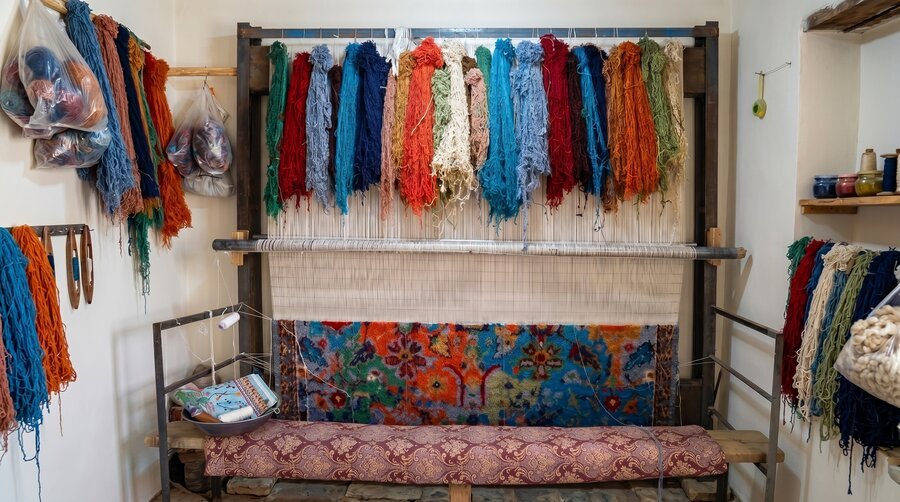
Setting up the loom — a wooden or metal frame is built and vertical warp threads are strung from top to bottom.
Taar dawani — the warp threads are tensioned carefully. These are the skeleton of the carpet.
Design preparation — a paper grid (naqsha) maps the pattern. Each square corresponds to one knot. The weaver works from this map, selecting colors row by row.
Knotting — colored pile threads are knotted around pairs of warp threads, one knot at a time. Two knot types appear in Afghan weaving: the Persian (asymmetric, or Senneh) knot, the most widely used across Afghan, Iranian, and Central Asian carpets, and the Turkish (symmetric, or Ghiordes) knot, used by some Turkmen weavers. Which knot a weaver uses comes down to tribe and workshop tradition more than strict geography.
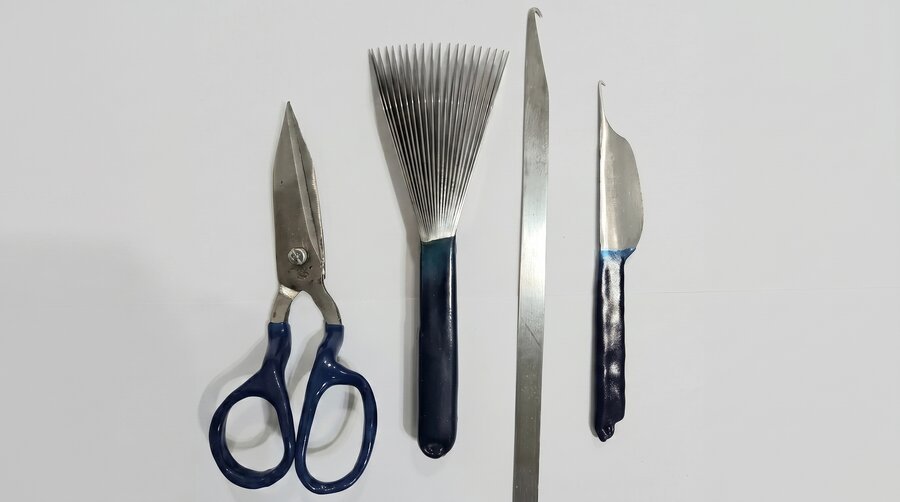
Beating down — locks each row of knots in place. A horizontal weft thread (pud) passes through the warp twice: the first pass straight through as the warp threads sit, the second after the top and bottom warp threads swap positions. A metal comb beats the weft down tightly against the knots after each pass. Once the second pass is done, the warp threads return to their original order and the next row of knots begins.
Clipping — keeps the pile even and the pattern clear. Practice varies: some carpets are clipped with scissors during the weaving itself, row by row; others are left untrimmed until the carpet is off the loom, when the pile is sheared afterward — in some Kabul workshops, by the merchant, with specialized machinery, aiming for a short, close-cropped finish.
Finishing — for the weaver, this means a small flat-woven band (a kilim end) at both the start and end of the carpet, about 3 cm, weft only, no knots, passed back and forth and beaten down tight to secure the warp. A temporary glue is sometimes applied to the ends to keep them from unraveling before delivery. Washing, stretching flat to dry, and cutting and tying the warp into a fringe — if done at all — is left to the merchant, after the carpet is delivered.
How carpets are graded
Beyond regional style, every carpet is graded by baft (بافت) — the density of the weave, measured on two axes: knots per row, and rows per meter.
Double baft — the thick weave
Lower density on both axes: fewer knots per row, and fewer rows needed to fill a meter. Three grades fall under it.
- Normal — the simplest graph: small motifs repeating from end to end. A weaver can work most of it from memory after the first stretch. Lowest-grade material, lowest wage.
- Qazzaq — same material tier as normal, but roughly 1.5× the wage. The graph still repeats, but the motif is much larger, repeating only six to eight times across a whole carpet. (This is the same Qazzaq recognized internationally as the Kazak rug — bold geometric, large-scale motifs.)
- Marinus — much finer material, with a silk-like sheen. The graph never repeats, so the weaver reads the map row by row without a break. Roughly double the normal-grade wage.
Maiin baft — the thin weave
Up to double the density of double baft on both axes — meaning up to four times the knots, and far finer color and pattern reading.
- Silk — a finer version of the normal repeating graph, but at this density the small scale makes it far more demanding. Highest-grade, most expensive material. Wage four to five times the normal double-baft tier. Because the material cost is so high, only experienced weavers are given this work.
For a standard two-square-meter carpet, grade also sets the timeline: under a month to weave in double baft, around two months in the silk grade.
The famous types
This is a different axis of classification altogether: not density or labor, but the region and community a carpet comes from. These are also the names that travel — what international buyers and dealers call a carpet, rather than the grading vocabulary used on the workshop floor.
Turkmen carpet
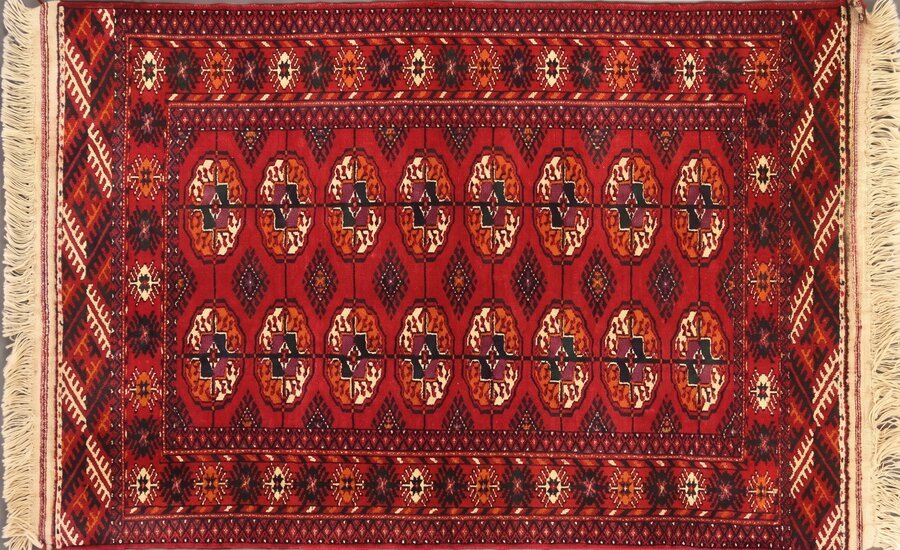
The most internationally recognized Afghan carpet. Woven by Turkmen communities, mainly in the north. The signature feature is a repeating medallion pattern called gul (flower), set against a deep red background. The pile is tight and the wool quality is consistently high. Outside Afghanistan, these are sometimes called Bukhara carpets.
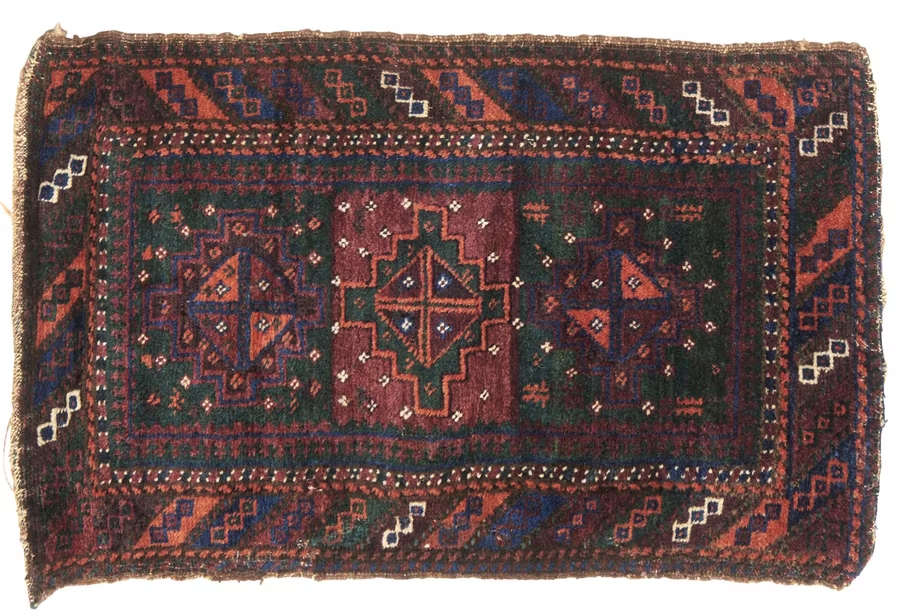
Baluch carpet
One of Afghanistan’s two principal carpet traditions, alongside Turkmen. Woven in the southwest — Farah, Nimroz, Helmand, and parts of Kandahar and Herat. Dark, earthy colors dominate: deep reds, near-black navy, browns, and ivory, drawn from natural dyes like madder root and walnut husk. Patterns are geometric — octagons, diamonds, and tribal guls specific to individual clans — and Baluch prayer rugs are known for the Tree of Life motif.

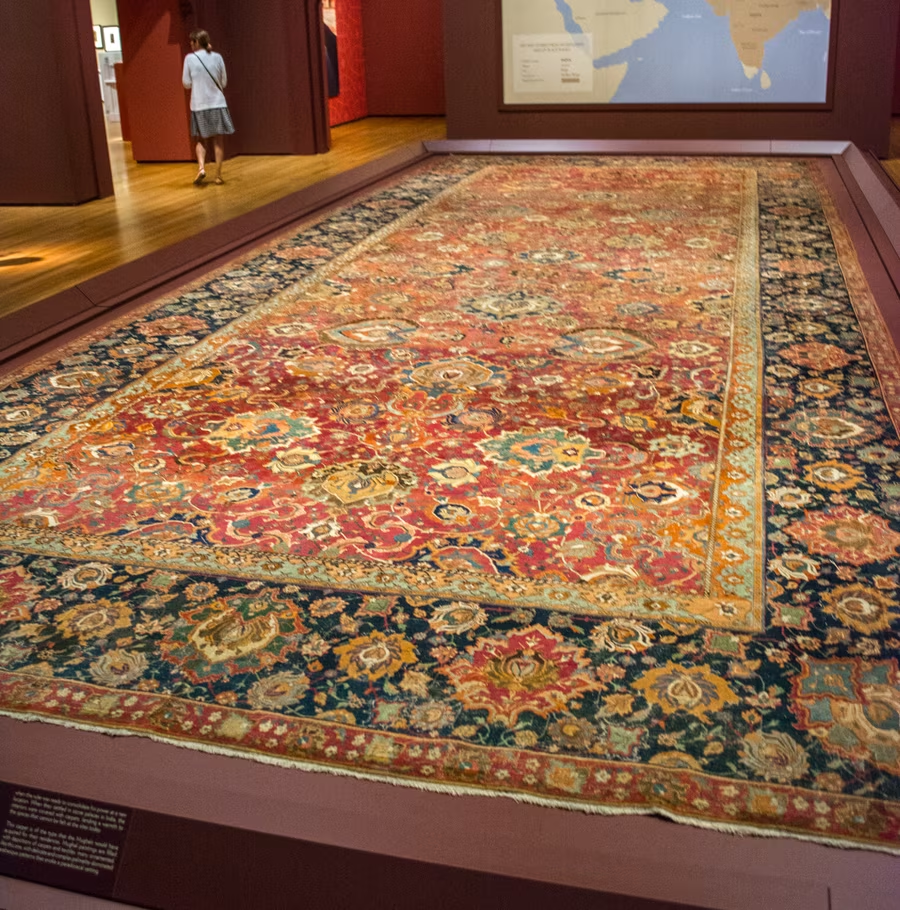
Herati carpet
Produced in and around Herat. Known for fine knotting, floral and arabesque (islimi) designs, and a wider color palette — deep reds, blues, and cream. Herati carpets are considered among the most technically accomplished Afghan styles.
.jpg)
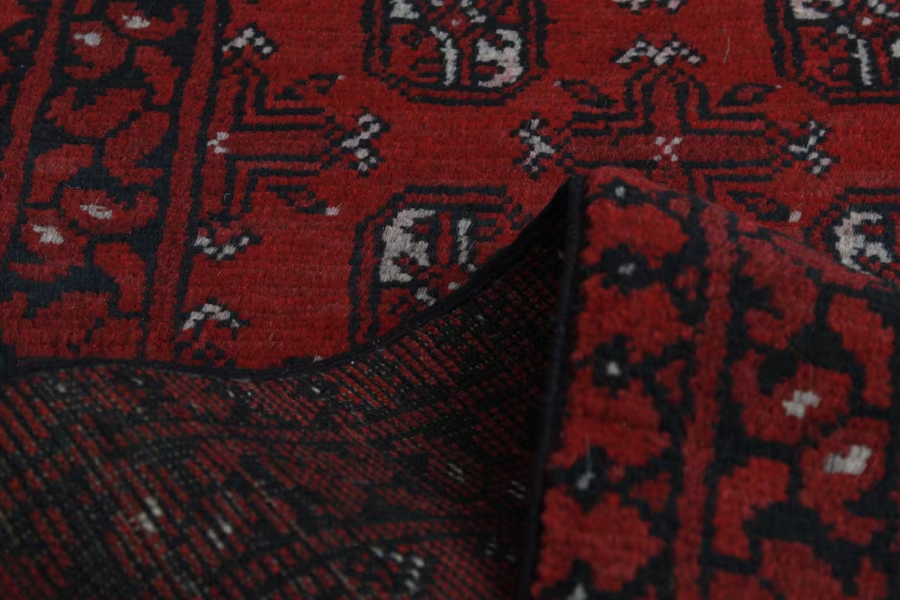
Balkhi carpet
Made in northern Afghanistan. Simpler geometric patterns than Herati work, with natural wool tones. Sturdy and built for use rather than display.

How the craft evolved
Early period — simple rugs and mats made for use in tents and homes. Functional first, decorative second. Designs were tribal and held in memory.
Traditional period — carpet weaving became a refined craft. The regional styles — Turkmen, Baluch, Herati, Balkhi — took their definitive forms. Designs grew more complex, natural dyes became more controlled, and the carpet became a cultural marker as much as a floor covering. A Turkmen carpet was not just something to walk on — it identified a family and its heritage.
Global market period — in the 19th and 20th centuries, Afghan carpets reached European and American markets. Export demand pushed production toward consistent quality and standardized sizing. The name Afghan Carpet became a recognized category in international trade.
Modern period — today, Afghan carpet production runs on two tracks. Traditional hand-knotted work continues in rural areas and remains the country’s most valued export handicraft. Alongside it, a more commercial production has emerged: contemporary designs, lighter colors, and formats suited to modern interiors and hotel buyers.
Economic and cultural weight
Carpet weaving employs hundreds of thousands of Afghan families — by some estimates, over a million people work in the sector, close to 3 percent of the population. It is one of the country’s most significant export industries and a source of foreign currency. The associated trades — spinning, dyeing, trading — support many more.
Culturally, Afghan carpets carry memory. The patterns in a Turkmen carpet reflect that community’s history and visual language. These are not decorative choices — they are inherited forms.
Final note
Afghan carpets are well known internationally, and that reputation was built by the people who make them — not by branding.
Do you have a comment or something to share? contact us: info@aboutafg.com